Technology Integration
Sensor Fusion: Unified Situational Awareness from Every Input
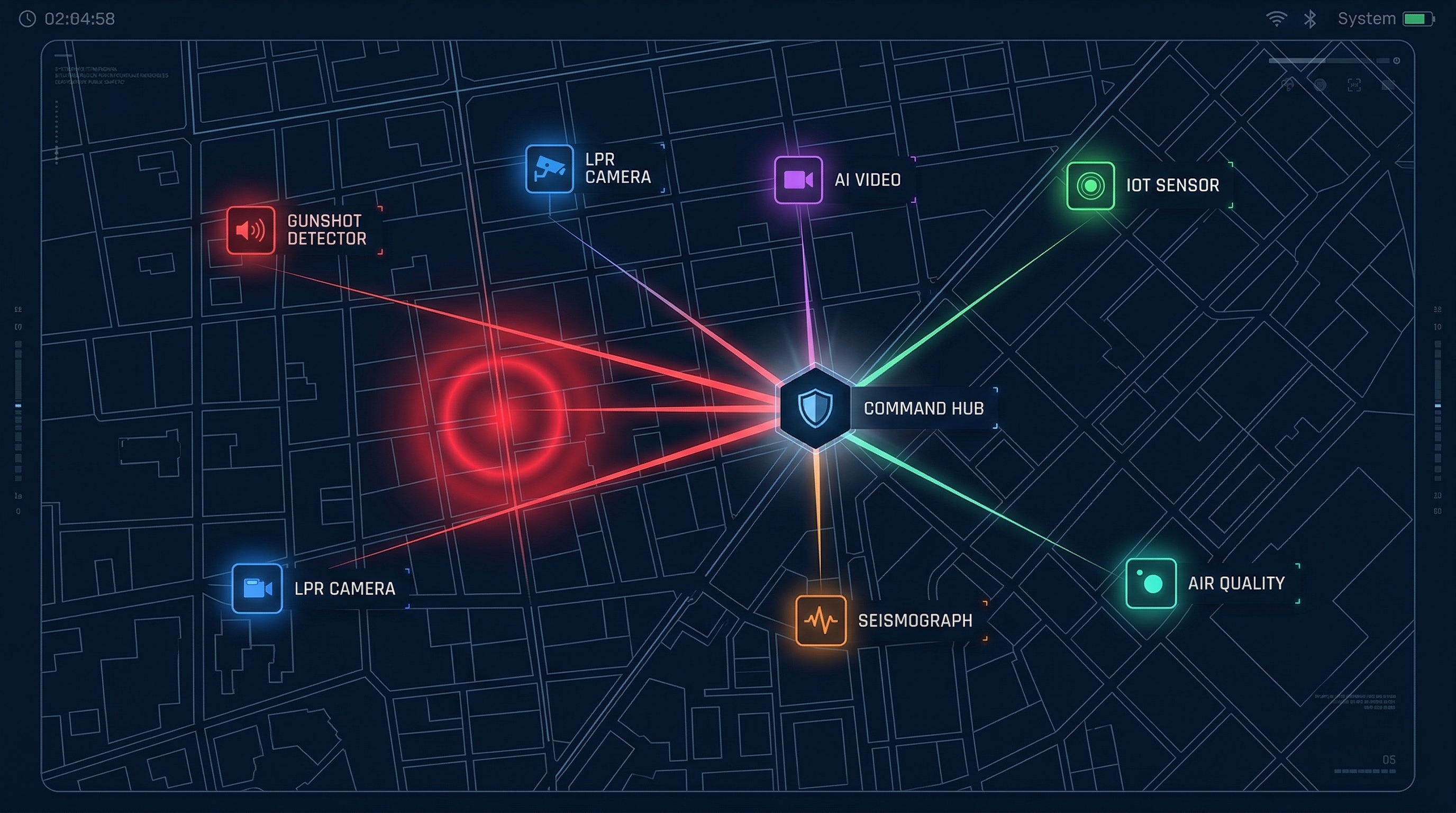
An isolated gunshot, an out-of-range air quality sensor, and three social media reports about an incident on the same block. Separately, they are individual alerts. Together, they are evidence of an emergency. KabatOne automatically correlates multiple sensor sources to give you the complete picture — not fragments.
What Is Sensor Fusion?
Sensor fusion is the automated integration and correlation of data from multiple heterogeneous sources to create a more complete and reliable operational picture than any single sensor. The principle is simple: no single sensor is perfect. Cameras don't "hear." Gunshot detectors don't "see." Environmental sensors don't detect suspicious behavior. But when they all work together and their data is correlated in real time, the result is a qualitatively different situational understanding.
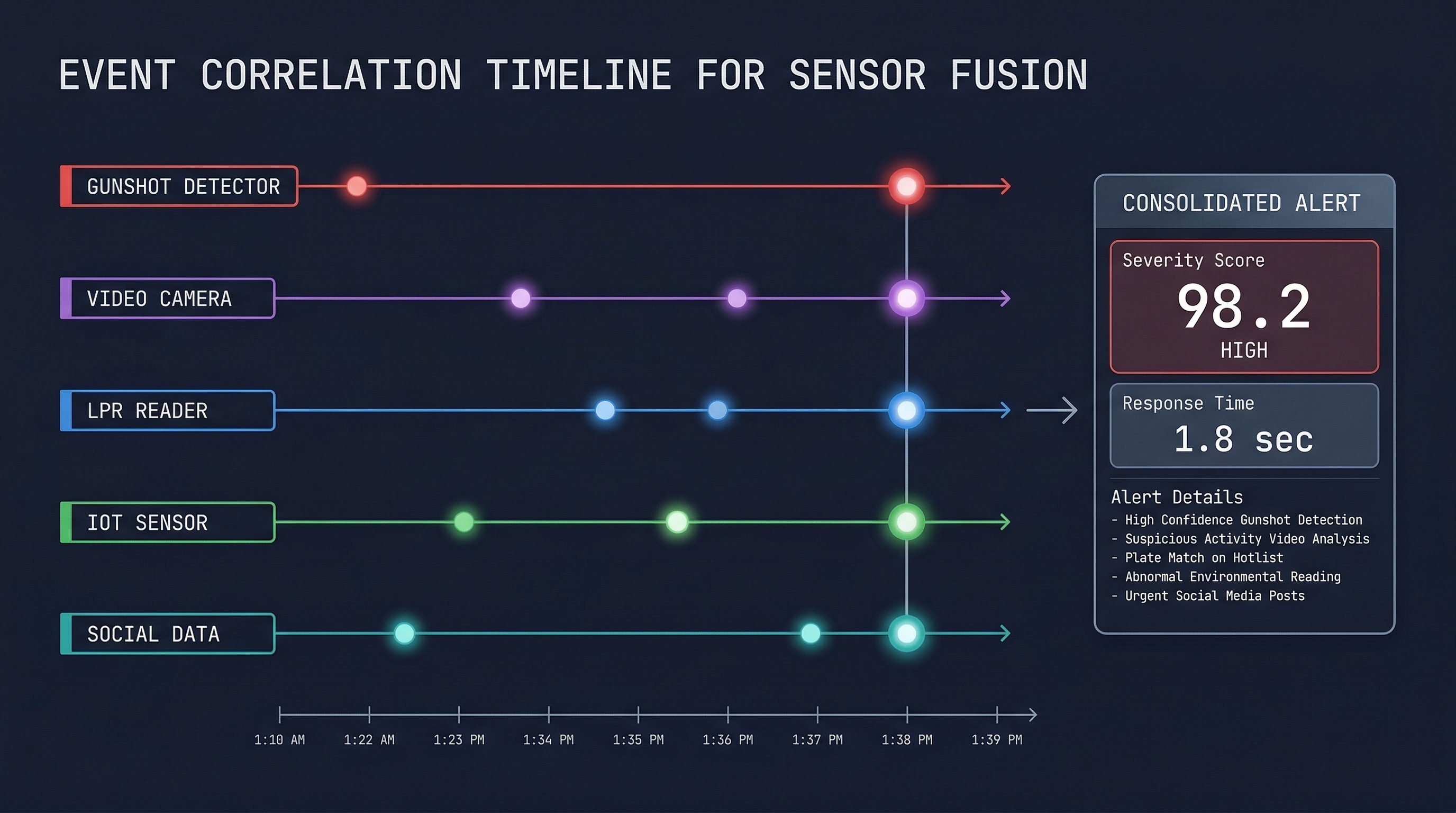
In public safety operations, sensor fusion reduces detection and response times because the system identifies patterns that humans could not manually detect. A single gunshot can be ambiguous — fireworks, a tire blowing out. But an acoustic gunshot confirmation + abnormal movement on the area camera + a vehicle with an active alert passing the nearby LPR — that composite pattern is unambiguous, and KabatOne can generate a consolidated alert in under 2 seconds.
Unlike PSIM (Physical Security Information Management) systems that simply aggregate alarms from siloed systems, KabatOne applies intelligent correlation: events are only consolidated into an alert when multiple independent sources confirm them, with configurable confidence weights and time windows. This dramatically reduces false positives without missing real events.
Sensors KabatOne Integrates
KabatOne connects sensors via standard APIs (REST, MQTT, ONVIF) and IoT protocols. The most common sensor types in current deployments:
Gunshot Detection
Acoustic detectors that triangulate the origin of gunshots in seconds. Integration with ShotSpotter, SST Sentri, Shotpoint, and compatible systems.
Environmental IoT Sensors
Air quality (PM2.5, CO, NO2), temperature, humidity, water level. Automatic alerts by configurable thresholds per zone.
Urban Seismographs
Early earthquake detection and vibration monitoring in critical infrastructure. Integration with national and local seismological networks.
AI Video
Cameras with integrated analytics that generate structured events: person in restricted zone, stopped vehicle in lane, abnormal crowd.
LPR & Biometrics
License plate readers and cameras with facial or behavioral recognition integrated into the sensor correlation flow.
Georeferenced Social Data
Social media monitoring with geolocation for early detection of disturbances, accidents, or emergencies reported by citizens.
How the Correlation Engine Works
KabatOne's correlation engine processes all sensor events in real time and applies configurable correlation rules:
Real-Time Ingestion
All sensor events arrive at the correlation engine with latency under 500 ms. Each event includes timestamp, geographic coordinates, sensor type, and confidence level from the source sensor.
Normalization & Enrichment
Heterogeneous sensor data is normalized to a common format. Each event is automatically enriched with geographic context: city zone, nearby LPR coverage radius, closest cameras.
Spatio-Temporal Correlation
The engine groups events within configurable windows of time (e.g., 60 seconds) and distance (e.g., 200 meters). Events from multiple sensors that overlap temporally and spatially are automatically correlated.
Confidence Scoring
Each correlation receives a composite score based on: number of confirming sensors, types of sensors involved, and historical precision of each sensor in that zone. Correlations above the configured threshold generate alerts.
Consolidated Alert to Operator
The operator receives a single consolidated alert with all relevant information: which sensors confirmed the event, the map with exact location, live video of the area, and the closest available units.
Real-World Operational Use Cases
How sensor fusion improves operational response in real-world scenarios:
Gunshot Response
The acoustic detector identifies gunshots and alerts the system. In under 2 seconds, K-Safety automatically activates the nearest cameras to the triangulated location, K-Dispatch notifies available units, and the analyst has live video of the area — all before the first 911 call arrives.
Perimeter Intrusion
At critical facilities — substations, data centers, port installations — motion sensors, video cameras, and vehicle access readers work together. Movement detected by sensor is confirmed with video, and if the vehicle is not on the authorized access list, a high-priority consolidated alert is generated.
Environmental Emergencies
An abnormal spike in CO readings in a neighborhood, combined with multiple social media reports mentioning a strange smell, may indicate a gas leak. IoT sensor + social data correlation enables earlier detection than waiting for 911 calls, enabling a preventive response.
Related Products
KabatOne for Sensor Fusion Operations
KabatOne modules that receive and process fused sensor data:
Frequently Asked Questions
Common Sensor Fusion Questions
What is sensor fusion in public safety?
Sensor fusion is the process of combining data from multiple heterogeneous sources — video cameras, gunshot detection sensors, environmental IoT sensors, seismographs, license plate readers, georeferenced social media data — to create a more complete and reliable operational picture than any single sensor can provide. The term comes from military and aeronautical technology, where combining radar, sonar, and infrared imaging gave much more accurate "situational awareness" than any individual technology.
What types of sensors can KabatOne integrate?
KabatOne integrates sensors via standard APIs and IoT protocols. The most common sensor types integrated in current deployments include: acoustic gunshot detectors (ShotSpotter, SST, Sentri), air quality sensors, water level sensors for flood alerts, urban seismographs, temperature and humidity sensors for extreme heat alerts, license plate readers (LPR), video cameras with AI analytics, and georeferenced social media feeds. If the sensor has an API or generates data in a standard format, it can be integrated.
How does sensor fusion reduce false positives?
Individual systems have false positive rates that can be manageable in isolation but problematic at volume. A gunshot detector may generate alerts for fireworks, blown tires, or slamming metal doors. A motion sensor may trigger for animals or authorized personnel. When multiple independent sensors generate related alerts at the same location and time — gunshot + camera detects abnormal movement + LPR sees a suspicious vehicle — the probability that it is a real event increases dramatically. KabatOne applies a configurable correlation engine that only generates high-priority alerts when multiple sources confirm the event.
How fast can the system correlate events?
KabatOne's correlation engine processes events in real time with latency under 500 milliseconds from receipt of the first event. Temporal correlation is configurable: the system can group events occurring within a 30-second to 5-minute window and within a geographic radius of 50 to 500 meters, depending on the agency's operational protocols. For high-priority events like gunshots, the consolidated alert reaches the operator in under 2 seconds.
Does sensor fusion require special infrastructure?
No. KabatOne is designed to work with existing network infrastructure. Sensors connect via internet or private networks using standard protocols (MQTT, HTTP/REST, ONVIF). Processing happens in the KabatOne platform, which can be in the cloud, on the municipality's on-premise servers, or in a hybrid configuration. For low-power IoT sensors in remote areas, KabatOne supports LoRaWAN and LTE/4G connectivity to transmit data to the central platform.
Can the system learn and improve over time?
Yes. KabatOne's correlation engine includes adaptive learning capabilities: the system records which correlations resulted in confirmed real incidents and which were false positives, and automatically adjusts weights and confidence thresholds. With 3–6 months of operation in a specific environment, the false positive rate in consolidated alerts can be reduced by up to 60% from initial values. Operators can also manually provide feedback by marking alerts as valid or invalid.
Get Started
Connect All Your Sensors in One View
KabatOne integrates gunshot, IoT, video, and LPR sensors in a unified situational awareness platform. Request a demo with real city data.