Technology Integration
LPR Integration: Real-Time Vehicle Intelligence
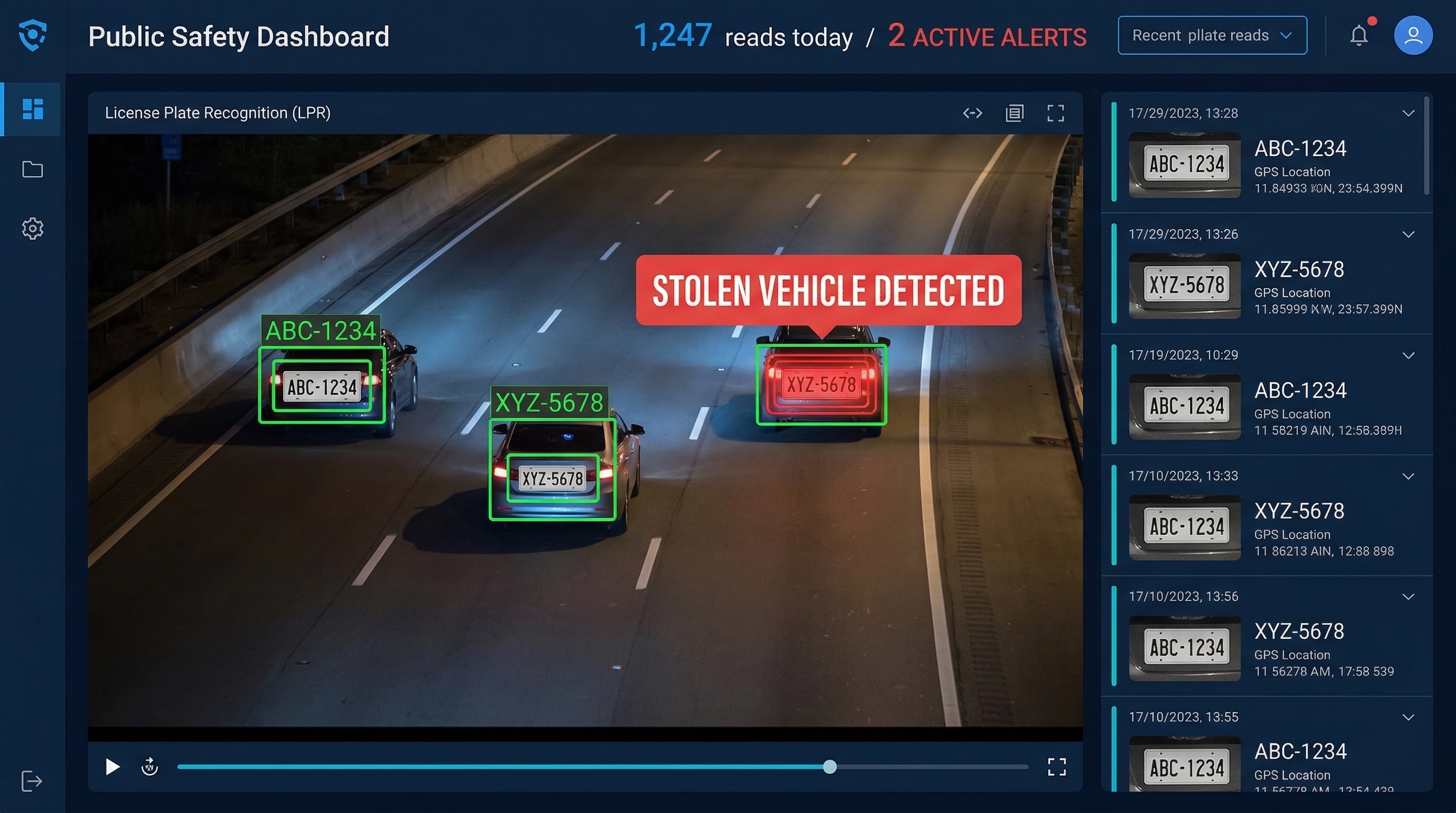
License plate recognition turns every monitored corridor into a tactical intelligence point. KabatOne integrates LPR natively with video management, CAD dispatch, and GIS so that when a plate of interest appears on the network, the dispatcher has full context in seconds — not minutes.
What Is License Plate Recognition?
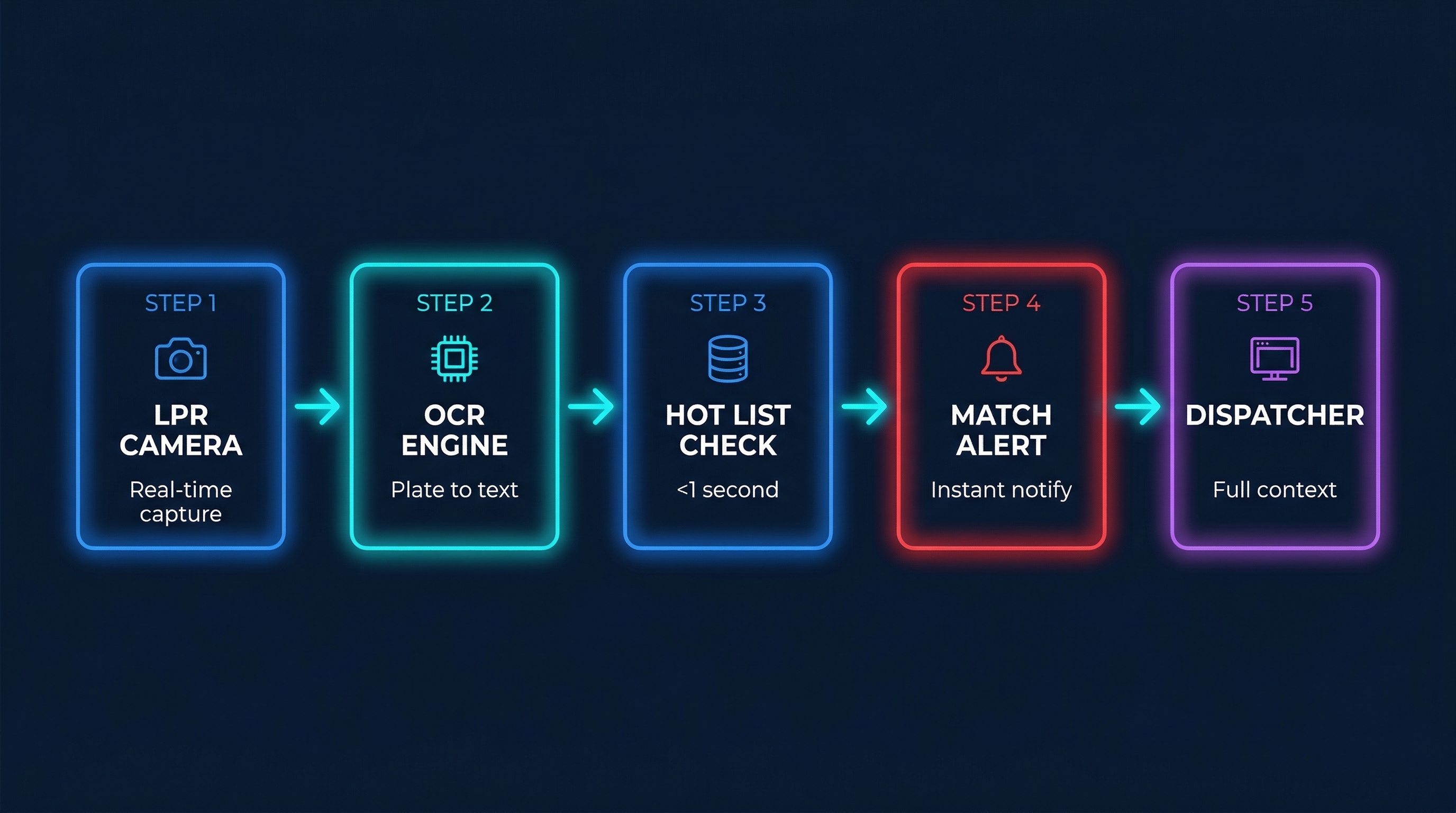
License Plate Recognition (LPR, also called ALPR — Automatic License Plate Recognition) is a system that captures images of vehicle license plates in motion, converts them to text using optical character recognition (OCR), and automatically cross-references them against alert databases. The entire process occurs in under one second — far faster than a human operator could manually review.
Modern LPR cameras are much more than simple security cameras. They use high-speed electronic shutters, active infrared illumination, and specialized computer vision algorithms to capture sharp plates in any condition: rain, night, high-speed moving vehicles, partially obscured plates. The most advanced systems can process multiple lanes simultaneously and detect several vehicles in the same image.
Integration with operational platforms like KabatOne is what transforms LPR from a passive logging tool into an active intelligence tool. Without integration, LPR reads are stored data that someone has to query manually. With integration, alerts are generated automatically and reach the right dispatcher at the right moment, with video and location context already included.
How KabatOne Integrates LPR
KabatOne K-Video is vendor-agnostic for LPR cameras. Regardless of brand — Axis, Hikvision, Genetec AutoVu, Neology, Vigilant/Motorola — K-Video receives LPR events via standard API or ONVIF/SDK integration and processes them in the unified platform.
When an LPR camera registers a read, K-Video automatically cross-references it against all configured alert lists. If there is a match, a high-priority alert is generated that appears simultaneously on the K-Safety GIS map, on the K-Dispatch dispatcher console, and on the analyst screen — with the plate image, the live video feed from the read point, and all previous reads of that plate in recent days.
For reads without alerts (99%+ of traffic), the data is stored in a queryable database with configurable retention. Investigators can search a plate and get a complete movement history — date, time, location, image — in seconds. This history is admissible as digital evidence when generated by the system with documented chain of custody.
Integration Flow
From Plate to Alert in Under 3 Seconds
Primary Use Cases
LPR integrated with KabatOne has direct applications in police operations, criminal investigations, and traffic management:
Stolen Vehicle Recovery
When a plate registered as stolen passes in front of any LPR camera in the network, the system generates an immediate alert to the dispatcher with the exact location, live video feed, and the most recent reads from that plate. Average detection time is under 3 seconds from the crossing.
BOLO and Wanted Vehicle Alerts
Operators can create local watch lists (BOLO — Be On the Lookout) in real time without needing to update central databases. A suspect's vehicle in an active investigation can be added to the list in seconds and detected at any point in the LPR network.
Traffic Management and Vehicle Counts
General traffic LPR reads allow calculating average speeds, travel times, and vehicle flow by corridor. This information feeds K-Traffic's signal optimization algorithms and can detect abnormal congestion indicating accidents or blockages.
Digital Evidence Collection
When a crime occurs, investigators can query the LPR read history from the past days or weeks to track the suspect vehicle's movements. The query includes the plate image, full vehicle image, GPS location, and exact timestamp — all in a single exportable report.
Technical Capabilities
Technical specifications of the LPR system integrated in KabatOne for public safety operations:
| Capability | Specification |
|---|---|
| Read accuracy | 95–99% under optimal conditions |
| Processing speed | Up to 125 mph |
| Alert time | < 3 seconds from read |
| Vendor compatibility | Axis, Hikvision, Genetec AutoVu, Neology, Vigilant, and more |
| Data retention | Configurable: 30 days to 5 years |
| Concurrent access | Multiple simultaneous users with permission controls |
| CAD integration | Native bidirectional with K-Dispatch |
| Evidence export | PDF, CSV with image and chain-of-custody metadata |
Related Products
KabatOne for LPR Operations
KabatOne modules that work together with LPR integration:
Frequently Asked Questions
Common LPR Questions
What is License Plate Recognition (LPR/ALPR)?
License Plate Recognition (LPR, also called ALPR — Automatic License Plate Recognition) is a technology that captures images of vehicle license plates in motion and converts them to searchable text in real time. LPR cameras can process dozens of vehicles per second and automatically cross-reference them against alert databases — stolen vehicles, plates with active alerts, vehicles belonging to wanted persons.
How accurate is LPR in real-world conditions?
Under optimal conditions (adequate lighting, speeds below 60 mph, clean plate), modern LPR systems achieve 95–99% accuracy. In adverse conditions — heavy rain, night without adequate lighting, dirty or damaged plates — accuracy can drop to 80–90%. That is why public-safety-grade systems use multiple reads per vehicle and confirm before generating an alert. KabatOne applies a confirmation process with a configurable threshold to reduce false positives.
What cameras are compatible with KabatOne LPR?
KabatOne K-Video supports LPR cameras from all major manufacturers — Axis, Milestone, Hikvision, Dahua, Genetec, and dedicated LPR cameras from specialized vendors like Genetec AutoVu, Vigilant/Motorola, and Neology. The architecture is vendor-agnostic: K-Video receives LPR events via API or ONVIF/SDK integration and incorporates them into the platform without requiring proprietary hardware.
Can LPR read plates on vehicles moving at high speed?
Yes. Public-safety LPR cameras are designed to capture moving vehicles at speeds up to 125 mph. They use high-speed electronic shutters and infrared illumination to capture sharp images regardless of lighting conditions. For highway and high-speed corridor operations, KabatOne recommends LPR cameras with integrated IR illumination and minimum 2MP resolution.
What databases can be integrated with the LPR system?
KabatOne can integrate with multiple alert databases: stolen vehicle registries (REPUVE in Mexico, NCIC in the United States), wanted persons' vehicle lists, outstanding warrant databases, vehicle access control records, and locally created watch lists. Alerts are configured by priority, and the system can activate different protocols based on the type of alert detected.
How is privacy handled with LPR data?
KabatOne applies granular access controls: only users with specific permissions can query the movement history of a plate. LPR read data is retained for a configurable period (typically 30–90 days for records without alerts), and every query is logged for audit. In the United States, LPR use in public spaces varies by state; KabatOne supports configurable retention policies and data minimization practices.
Get Started
Integrate LPR with Your Command Center
KabatOne connects license plate readers from any vendor with your CAD, video, and GIS system. Request a demo with real city data.