Technology Integration
Face Recognition Integration: AI-Powered Biometric Matching
Facial recognition in public safety is a powerful tool when implemented correctly — with rigorous privacy controls, mandatory human confirmation, and a complete audit trail. KabatOne integrates facial recognition with those controls built in, not as optional add-ons.
What Is Facial Recognition in Public Safety?
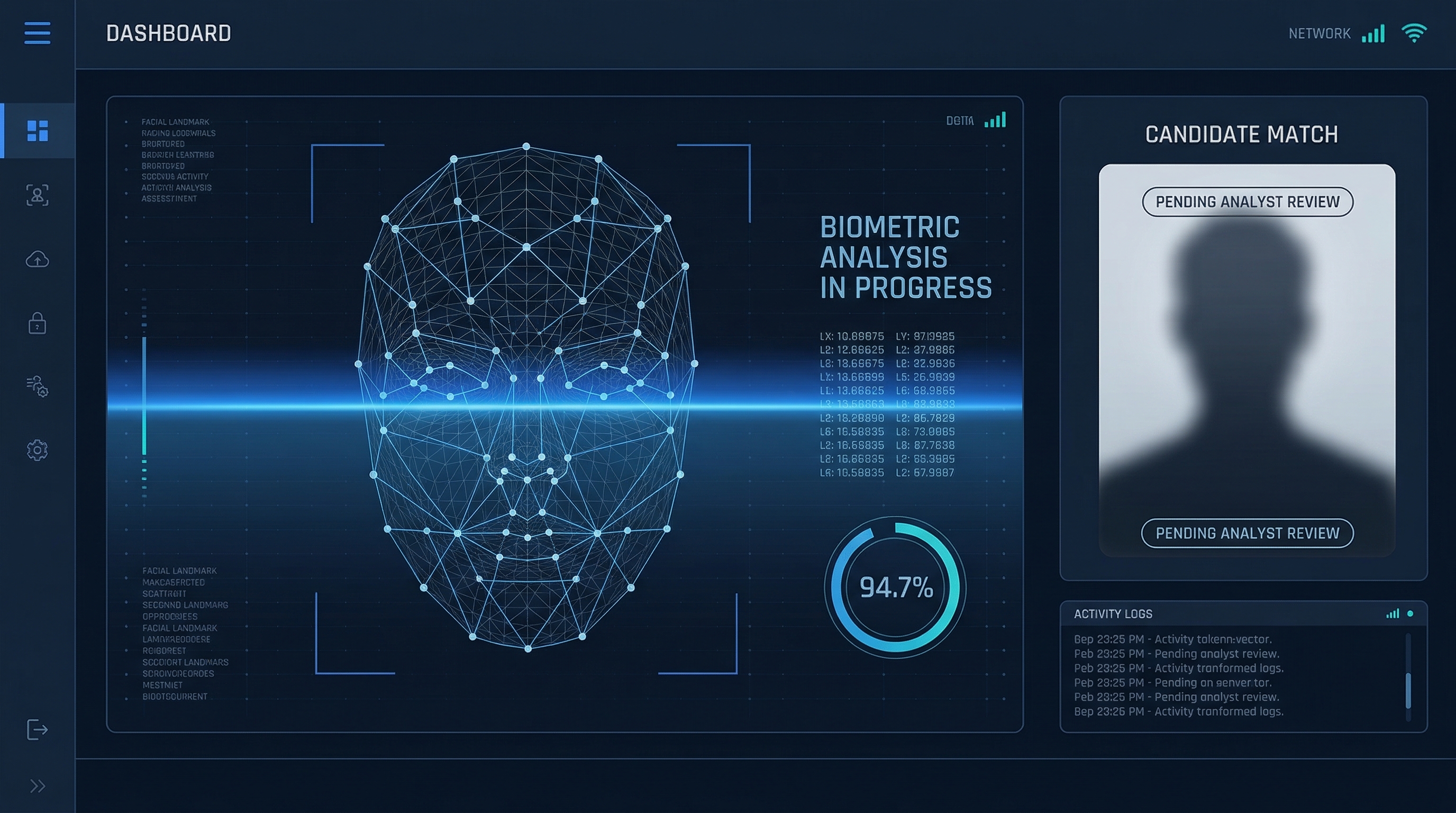
Facial recognition is an artificial intelligence technology that analyzes the geometric features of a human face — distance between eyes, jaw shape, nose proportion — and generates a unique mathematical representation called a "feature vector" or "faceprint." This vector is compared against a database to find matches. The process is similar to fingerprinting, but operates on 2D images rather than physical impressions.
In public safety, facial recognition is used in two fundamentally different contexts with distinct operational and legal implications: forensic matching (retrospective suspect search in criminal investigations) and real-time matching (identification of persons on alert lists in live video cameras). KabatOne supports both modes with separate access controls because the applicable operational protocols and legal frameworks differ.
The critical difference between public-safety-grade facial recognition and consumer applications is the confirmation process. In a phone photo app, the algorithm tells you "this is your grandmother." In a public safety system, the algorithm says "there is a 92% probability that this person is John Smith, wanted for aggravated robbery" — and a verified human analyst makes the decision to act or dismiss. This distinction is not just an internal policy: it is the standard that separates responsible from irresponsible use.
Public Safety Use Cases
Scenarios where facial recognition delivers the most value in public safety operations:
Wanted Persons
The system compares in real time the faces captured by strategic cameras against the list of persons with active arrest warrants. When there is a match, the analyst receives an alert with the confidence percentage, the captured image, the person's profile, and the exact location — all before notifying field units.
Missing Persons
In missing persons cases — especially children and vulnerable elderly adults — facial recognition can dramatically accelerate location. The missing person's photograph is loaded into the system and matched against all network cameras in real time and against the read history from the past hours or days.
Crowd Monitoring at Events
At mass events (concerts, protests, soccer games), facial recognition allows identifying persons with a history of violence attempting to enter the venue, or persons on exclusion lists due to previous incidents. Detection occurs at access points before entry, not inside.
Critical Facility Access Control
At critical facilities — data centers, electrical substations, port installations — facial recognition replaces or complements access cards. It offers biometric verification that cannot be transferred or duplicated, and automatically logs every entry and exit with image and timestamp.
Privacy & Compliance: Built-In Controls
Facial recognition is the most civil-rights-sensitive public safety technology. KabatOne incorporates four privacy controls that are not optional — they are part of the base architecture:
Role-based access
Only users with explicit authorization can perform facial recognition queries. Access is logged, audited, and can be revoked in real time.
Full audit trail
Every query generates an immutable record: who searched, when, what image they used, and what result they obtained. This audit trail is exportable for oversight reviews.
No passive mass identification
KabatOne does not build identity profiles of persons not on alert lists. Face reads are not linked to identities without an intentional operator action.
Mandatory human confirmation
The system never acts autonomously. Every facial recognition match requires analyst confirmation before any operational alert or field action is generated.
Related Products
KabatOne for Face Recognition Operations
KabatOne modules that support facial recognition integration:
Frequently Asked Questions
Common Face Recognition Questions
How does facial recognition work in public safety?
Facial recognition in public safety works in two modes: real-time matching (comparing faces captured by live cameras against a database of persons of interest) and forensic matching (an investigator takes a still image — security camera photo, video capture — and compares it against databases to identify the subject). KabatOne supports both modes with separate access controls, given that the operational and legal implications differ.
What are the hit rate and false positive rates of the system?
Accuracy depends on image quality and capture conditions. Under front-facing conditions, adequate lighting, and minimum 1MP resolution, modern systems achieve identification rates of 95%+ with false positive rates below 1%. For real-time matching — with angled cameras, variable lighting, and subjects in motion — accuracy is lower. KabatOne applies a two-step confirmation process: the system suggests candidates with a confidence percentage, and a human analyst makes the final decision before any operational action.
Does KabatOne's facial recognition comply with privacy regulations?
KabatOne designs its facial recognition integrations with privacy-by-default controls: access restricted to authorized roles, complete audit trail of every query, configurable data retention, and an architecture that avoids mass storage of biometrics of persons without an alert. Specific legal compliance (CJIS in the US, data protection laws in Mexico) depends on the operating agency's use policy, not just the software. KabatOne provides the technical compliance tools; the agency defines the policy.
Can it integrate with external wanted persons databases?
Yes. KabatOne can integrate with external databases via secure API: AFIS (Automated Fingerprint Identification System) records that include facial data, wanted persons lists from state or federal agencies, and missing persons registries. Integration is via scheduled feeds or real-time alerts, with encrypted and authenticated access protocol. External database data is never stored locally on KabatOne servers — it is queried in real time.
What cameras are needed for facial recognition?
Not all surveillance cameras are suitable for facial recognition. Required: minimum 2MP resolution, field of view configured for facial capture (not panoramic), near-frontal capture angle (less than 30° lateral deviation), and adequate illumination for the operating range. PTZ cameras can be useful for active tracking, but the best facial recognition images come from well-positioned fixed cameras at passage points: turnstiles, access doors, pedestrian transit corridors.
How is algorithmic bias in facial recognition addressed?
Algorithmic bias in facial recognition is a documented problem, especially for certain demographic groups. KabatOne addresses this at three levels: selection of AI engines with demonstrated low bias rates in independent audits, mandatory human confirmation before any operational action (the system never acts autonomously), and monthly reporting of accuracy metrics by demographic group for early bias detection in production. Facial recognition in KabatOne is always an investigative tool, never an autonomous decision tool.
Get Started
Deploy Face Recognition with the Right Controls
KabatOne integrates facial recognition with privacy by design — full audit trail, human confirmation, and granular access control. Request a demo.