Technology Integration
Panic Buttons: Silent Alert, Immediate Response
When someone cannot speak but needs help right now, the panic button is the only channel that works. Integrated with KabatOne, one activation triggers dispatch, activates area cameras, and notifies the nearest units — all in under 4 seconds, all in silence.
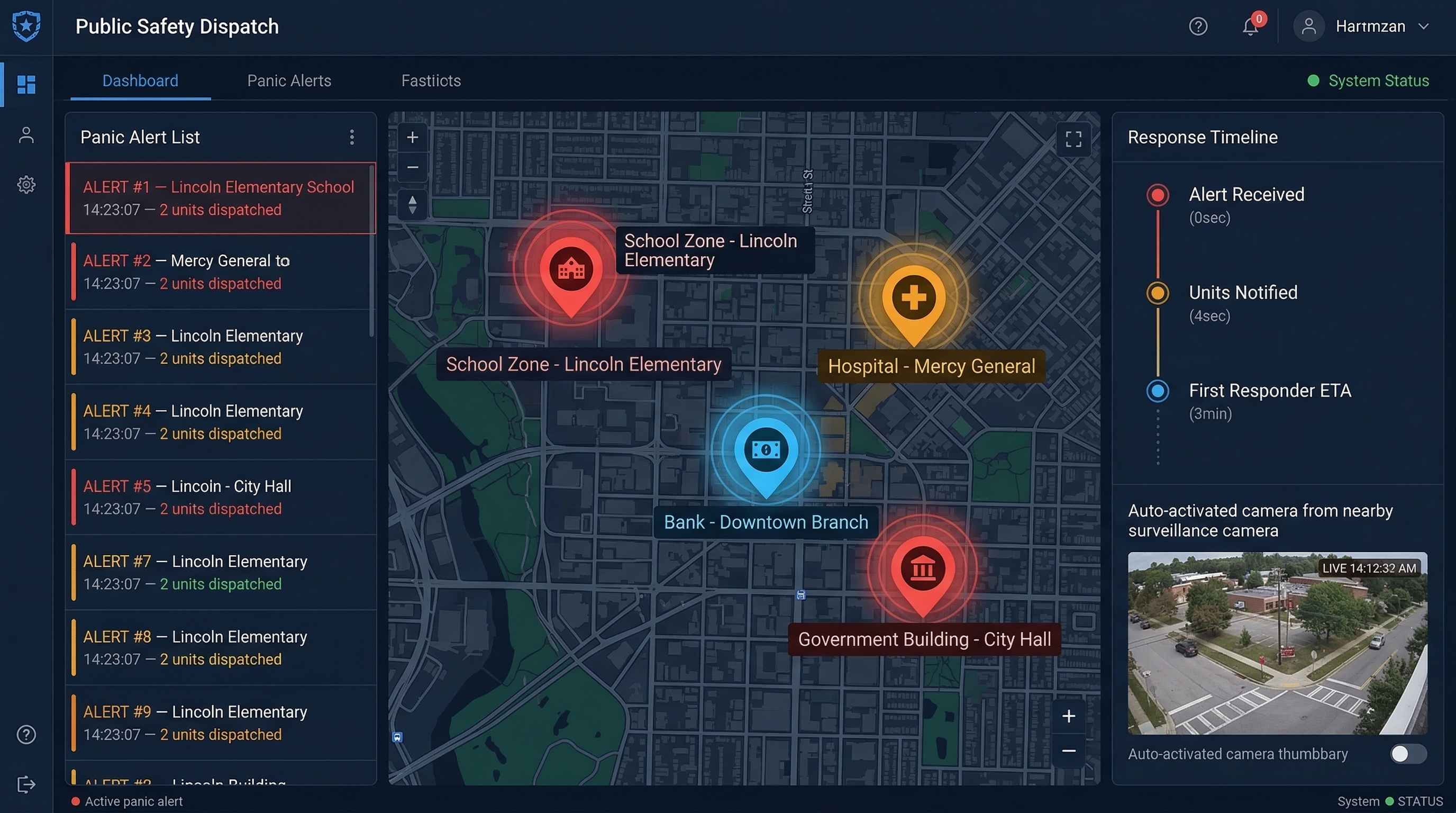
From Activation to Response in Under 4 Seconds
KabatOne's integrated response flow converts a button press into a coordinated emergency operation:
Button Activation
The user activates the panic button. The signal transmits immediately via WiFi, cellular, or radio to KabatOne's server.
K-Dispatch Alert
In under 4 seconds, K-Dispatch creates a maximum-priority incident with the activator's name, exact location, and configured emergency type.
Automatic Camera Activation
K-Video automatically activates the cameras nearest to the activator's location. The dispatcher sees area video without manually searching.
Unit Notification
K-Dispatch notifies the nearest available units with all information: location, alert type, response protocol, and live video feed.
Tracking & Closure
The incident is automatically documented: activation time, response time, dispatched units, resolution. All with chain of custody for reports.
Use Cases by Sector
Panic buttons integrated with KabatOne serve any organization where personnel face risk situations:
Schools & Educational Campuses
Teachers and staff with portable badge devices. Activation → automatic building lockdown + 911 dispatcher notification + hallway camera feed + active response protocol. No speaking. No manually dialing 911.
Hospitals & Healthcare
Nurses and physicians in high-risk areas (ER, psychiatric, pediatric ER) with portable buttons. Alert includes employee name, location on hospital floor plan, and response code (code gray, code violet) to coordinate internal security team.
Banks & Currency Exchange
Fixed under-counter and portable teller buttons. Silent activation that doesn't alert the attacker. Alert to dispatcher with area cameras activated and units dispatched before the suspect leaves the premises.
Government Offices
Public-access government buildings (registration offices, courthouses, immigration offices) where staff may be threatened. Buttons at every public service counter, integrated with building security and municipal dispatch.
Field Personnel & Agents
Field officers, inspectors, social workers, and any personnel operating alone in risk situations. Wearable devices or digital radio function with integrated GPS so dispatch knows exactly where they are when the alarm activates.
Public Transit & Drivers
Bus drivers, subway operators, school bus drivers. The button activates a silent alert to the control center with interior vehicle video and real-time GPS location — without the aggressor knowing help was called.
Related Products
KabatOne for Panic Alert Response
Modules that receive and process panic alerts:
Frequently Asked Questions
Common Panic Button Questions
What is a panic button and how does it work in a public safety platform?
A panic button is a device or software function that allows a person to send an immediate silent emergency alert. It can be physical hardware (fixed wall button, portable keychain device, button on a uniform sleeve) or software (mobile app with SOS button, alarm function on a portable radio). When activated, the alert reaches the dispatch system with the activator's exact location — immediately, without needing to speak, without revealing the situation to the aggressor.
How long does it take for the alert to reach the dispatcher?
With KabatOne, a panic button alert reaches the dispatcher in under 4 seconds from activation: the event transmits over network (WiFi, cellular, or radio), the system processes it and generates a high-priority incident in K-Dispatch, automatically activates the nearest cameras to the location, and displays the alert on the K-Safety GIS map with a blinking pin. The dispatcher has all the information to dispatch units without needing to speak with the victim.
What types of panic devices integrate with KabatOne?
KabatOne integrates any device that can generate an alert signal with identity and location data: fixed physical panic buttons (Inovonics, Napco, Bosch, ASSA ABLOY), portable badge devices (Aiphone, Alertus, Singlewire), mobile apps with SOS (API integration), digital radios with emergency button (Motorola, Kenwood, Hytera), and personal safety wearables. Integration is via REST API, MQTT, or webhooks depending on the vendor.
Do panic buttons work without network connectivity?
It depends on the device. WiFi or cellular-connected panic buttons require network coverage. For facilities with low-coverage zones (basements, server rooms, remote areas), KabatOne recommends long-range radio devices (LoRa, 900 MHz) or mesh radio systems that don't depend on building WiFi infrastructure. The most robust systems combine multiple communication technologies with automatic fallback.
Can the system distinguish between accidental and intentional activations?
Yes. KabatOne supports several strategies to reduce false alarms: requiring sustained activation (hold for 3 seconds), double activation (two presses in 2 seconds), or confirmation code to cancel the alert. More advanced systems include a 15–30 second cancellation window after activation, during which the user can abort if it was accidental. If not cancelled, the alert becomes an active incident. Typical false alarm rates with these controls are below 2%.
How are panic buttons used in schools?
In school safety protocols, KabatOne integrates teacher and administrative staff panic buttons with the municipal dispatch system. When a teacher activates their button, the 911 dispatch center automatically receives: teacher name, exact classroom, building floor plan with location marked, video feed from the nearest hallway camera, and a pre-configured response protocol (lockdown, evacuation, medical response). Police and EMS units receive notification simultaneously with the dispatcher.
What is a duress alarm system?
A duress alarm system is a silent alert mechanism that staff activate discreetly when under threat — without the aggressor knowing help was called. Unlike an audible alarm, a duress alarm sends a silent signal to the dispatch center with the activator's identity, exact location, and nearby camera feeds. Panic buttons integrated with KabatOne function as duress alarm systems in banks, courthouses, hospitals, and any environment where staff must alert without triggering visible panic.
How do panic buttons connect to 911 dispatch?
On the KabatOne platform, panic buttons connect to K-Dispatch (CAD dispatch) via direct IP protocol or integration middleware. When a device activates, the system automatically creates an incident in the CAD with the activator's geolocation, categorizes the response based on facility type (school, hospital, bank), and assigns the corresponding dispatch protocol. The dispatcher sees the alert on the operational map with the area camera feeds already loaded — without anyone needing to call 911 manually.
Get Started
Integrate Panic Alerts into Your Dispatch Center
KabatOne connects physical and wearable panic buttons with CAD dispatch, video, and GIS. Coordinated response in seconds. Request a demo.